A professional oven clean is usually far more detailed than a quick wipe with a supermarket spray. It is designed to tackle baked-on grease, carbon residue, splashes on the door glass and the grime that settles around shelves, runners and corners over time. When done properly, the result is not just a better-looking appliance. It is a fresher kitchen, a more pleasant cooking space and often a cleaner finish that stands up well to inspections.
What catches many people out is that oven cleaning is not always included in the same way across different services. Some cleaning companies bundle it into move-out work, while others price the inside of the oven separately from a standard deep clean. That distinction matters, especially for tenants, landlords and managing agents working to a tight timescale.
What professional oven cleaning usually covers
Most professional oven cleaning services focus on the greasy internal surfaces and the removable components that collect the heaviest residue. In simple terms, the core job is to degrease, loosen burnt deposits and clean the appliance until it is presentable and hygienic.
A proper clean often starts with the oven cavity, which is the internal chamber where the heaviest build-up forms. This includes the base, side walls, rear panel and roof of the oven. Food splashes and oil vapour tend to bake onto these areas layer by layer, which is why they usually need stronger products and more dwell time than an ordinary kitchen wipe-down.
The door is another major part of the service. Manufacturer guidance from Bosch makes clear that grease and grime can build up on the inside of the oven door glass, not just on the visible outside surface. In many models, the door or glass sections can be removed so that the internal panels can be cleaned properly. That is often one of the biggest differences between a household clean and a specialist clean.
A typical professional oven clean may include:
- oven cavity
- internal door glass
- external door and handle
- shelves and trays
- removable shelf supports
- visible seals and edges
Which oven parts are normally removed during oven cleaning
One sign of a thorough service is the treatment of removable parts. Shelves, racks, trays and shelf supports often hold the thickest grease because they sit directly in the cooking zone. Cleaning around them without removing them rarely gives a strong result.
Official appliance guidance supports this approach. Electrolux notes that removable shelf supports should be taken out before a pyrolytic cleaning cycle starts, and its appliance manual explains that supports, doors and internal glass panels can be removed for cleaning. NEFF also points out that self-cleaning programmes are not designed to clean oven racks. In other words, even on a modern self-cleaning appliance, many of the parts people notice first still need separate attention.
This is why professionals often remove and soak these items, then scrub and rinse them before refitting. That process helps deal with burnt-on fat around the edges, corners and joints where residue tends to harden.
In many cases, the removable parts include more than people expect.
- Oven racks: usually taken out, soaked and degreased separately
- Shelf supports: often unclipped or unscrewed for better access to the side walls
- Glass panels: in suitable models, internal door glass may be removed and cleaned on both sides
- Trays and grill pans: cleaned apart from the main cavity because they collect heavier deposits
Why oven door glass needs special attention
The door glass deserves its own mention because it can make or break the finished look. A customer might open the oven and find the cavity improved, yet still see streaks or trapped grease around the glass. That usually means the job was only surface-level.
Bosch advises using a degreaser on the oven glass and door, while avoiding unsuitable tools like glass scrapers or standard glass cleaner. Electrolux guidance also states that the inner door glass should be wiped before a self-cleaning cycle, and its manuals describe how internal glass panels can be removed and washed carefully with soap and water.
That tells you something useful about professional cleaning standards. The glass is not just a cosmetic extra. It is a recognised part of proper oven care, and a good service should treat it that way.
What may be excluded from a standard deep clean
This is where service descriptions matter. Many people assume that a kitchen deep clean automatically includes the inside of the oven. Sometimes it does not.
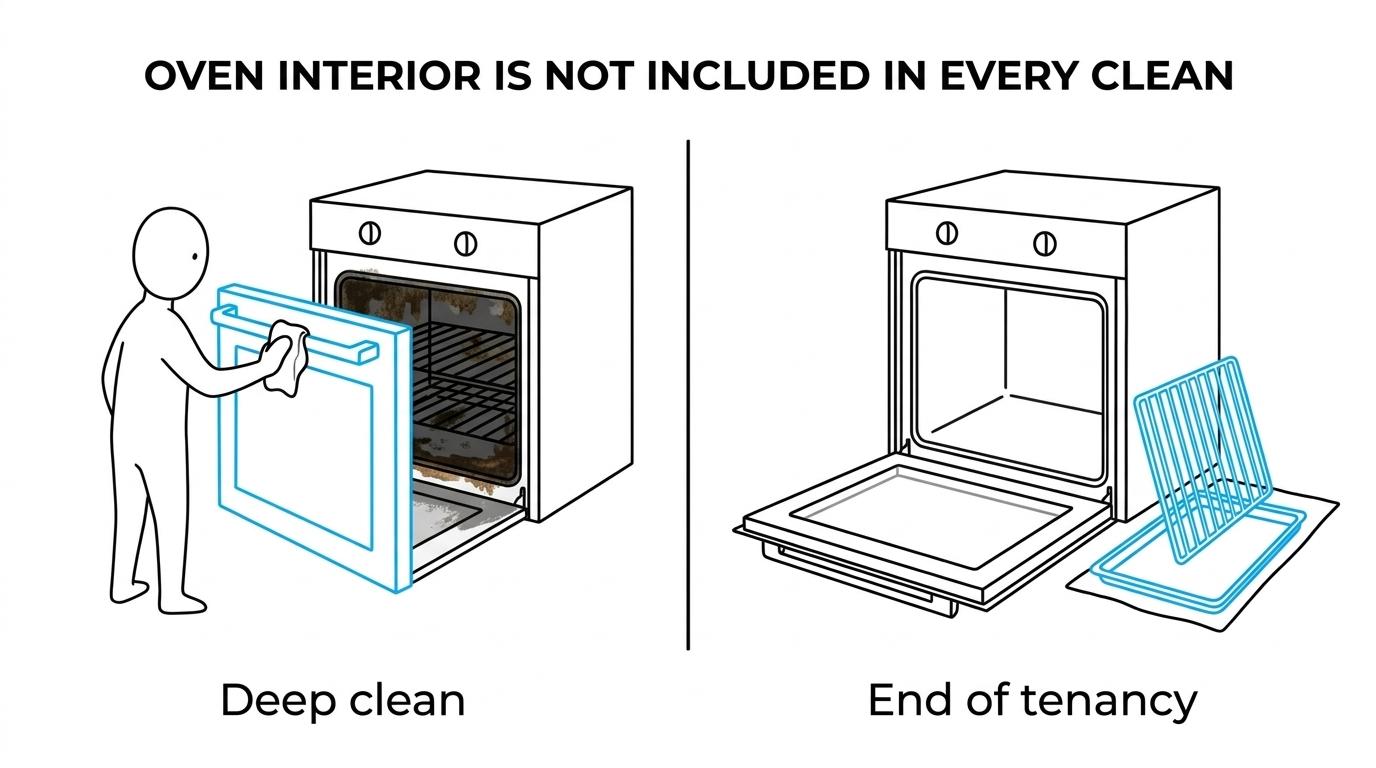
Some providers treat oven interiors as an add-on because they require extra labour, specialist degreasers and more time on site. CMH Cleaning states that its standard deep clean includes the hob, extractor hood and the outside of the oven, while the inside of the oven is priced separately. That same service model often applies to appliances like fridges, freezers and microwave interiors.
By contrast, end-of-tenancy cleaning can be broader. CMH Cleaning also states that its end-of-tenancy cleaning includes all kitchen appliances, including the oven, fridge and freezer, at no extra cost within that package. For tenants or landlords preparing for inspections, that difference can be useful because it reduces the risk of missed items.
Here is a simple comparison:
| Service type | Oven exterior | Oven interior | Other kitchen appliances | Typical use |
|---|---|---|---|---|
| Standard kitchen clean | Often included | Often excluded | Usually limited | Routine maintenance |
| Deep clean | Usually included | Sometimes add-on | Varies by provider | Periodic reset of the property |
| End of tenancy clean | Included | Commonly included | Commonly included | Move-out inspections and handovers |
How professional cleaners deal with self-cleaning ovens
Self-cleaning ovens can create false confidence. A pyrolytic programme is useful, but it does not replace all manual cleaning. Electrolux says pyrolytic cleaning heats the oven to around 500°C, turning dirt, grease and food residue into ash. That is effective inside the cavity, yet accessories and removable shelf supports need to be removed first.
That detail matters because it shows where professional input still adds value. Racks, supports and trays often need separate washing, and the inner door glass may still need manual attention. Even with a modern appliance, a complete clean is often a mix of the appliance’s own programme and hands-on work.
A good cleaner will also check the manufacturer’s guidance before removing parts. Not every oven door, rail or glass panel should be handled in the same way. Care is part of the service.
What affects the price of oven cleaning
The price of professional oven cleaning usually depends on the oven type, condition and service level rather than a single universal rate. A lightly used single oven will take less time than a double oven with years of baked-on residue. A range cooker, in turn, may involve several cavities, large shelves and more glass to clean.
Condition is often the biggest pricing factor. Fresh grease is much easier to remove than carbonised residue that has built up over months. If there is heavy smoke staining, burnt food fused to the base, or thick grease inside the door edges, the cleaner may need longer dwell times and repeat treatment.
Bundling also changes the price. If oven cleaning is booked as part of an end-of-tenancy package, it may be included within the full kitchen scope. If booked alongside a standard deep clean, it may appear as a separate line item. That is not unusual. It simply reflects the extra time and detail involved.
Common pricing influences include:
- oven size and type
- single, double or range configuration
- level of grease build-up
- removable parts and accessibility
- bundled package or stand-alone add-on
What to ask before booking an oven cleaning service
A short conversation before booking can prevent disappointment on the day. Service labels sound similar across the market, yet the detail can vary a lot. Asking the right questions gives you a clear picture of what will happen and what the final result should look like.
Start with the basics. Ask whether the quote includes the oven cavity, shelves, shelf supports and both sides of the door glass where accessible. Ask whether the cleaner removes internal glass panels if the appliance design allows it. Also ask whether products and equipment are included, as some companies build everything into the price while others list add-ons.
A few practical questions can be especially useful:
- Scope: does the price include the inside of the oven or only the outside surfaces?
- Removable parts: will racks, trays and shelf supports be taken out and cleaned separately?
- Door glass: is the inner glass cleaned, and can internal panels be removed where the model allows?
- Service type: is oven cleaning bundled into an end-of-tenancy clean but separate from a standard deep clean?
- Aftercare: is there any re-clean guarantee if the property is being prepared for inspection?
Why oven cleaning matters for inspections and handovers
Ovens attract attention during property check-outs because they reveal how thoroughly a kitchen has been maintained. A worktop can be polished in minutes. An oven tells a longer story. Built-up grease, smoked glass and dirty racks are difficult to hide, which is why inventory clerks and landlords often look closely at them.
For tenants, a professionally cleaned oven can support a stronger overall presentation of the property. For landlords and agents, it helps prepare a home to the standard expected for the next occupier. In commercial settings, it also supports a cleaner impression and a better-maintained kitchen area.
Inspection-ready cleaning is really about detail, and the oven is one of the clearest places where that detail shows.
What a strong oven cleaning result should look like
A professionally cleaned oven does not need to look factory-new to count as a success. Older appliances may keep some permanent marks or wear, especially where enamel has aged or previous damage is present. What matters is that grease, food residue and visible grime have been removed as far as safely possible.
A strong result usually means the cavity is degreased, the shelves are clean enough to handle without residue transfer, the door glass is visibly clearer and the corners, edges and runners are free from obvious build-up. It should smell fresher, feel better maintained and be ready for normal use or inspection.
That is the real value of the service. It brings an appliance back to a standard that looks cared for, functions in a cleaner environment and supports the wider condition of the kitchen.